


Tips for success
This section provides a site checkup schedule and some tips for operating the instrument in difficult site conditions.
Operating in dew
The LI-7500DS can tolerate droplets on the windows to a certain extent. The automatic gain control will increase, but the calibration is unchanged. If the droplets coalesce and get big enough, the CO2 Signal Strength will approach 0, and eventually the readings will become unusable. This can be minimized by tilting the sensor head 10 to 15° from vertical and by applying a water-shedding coating such as RainX® to the lower window.
Operating in rain and snow
Raindrops and snowflakes in the optical path will affect the performance of the LI-7500DS, even if the total light blockage does not drive the CO2 Signal Strength close to 0. The reason is that the droplets and flakes are moving, and if one is in the path for a sample measurement, but out of the path for a reference measurement (or vice versa), it will influence the reading. Figure 5‑1 is data taken during a light snow shower. The spikes are due to blockage changes between sample and reference readings. Notice that in some cases both CO2 and H2O are affected, and sometimes just one. Also, the spikes are equally likely to be up or down.
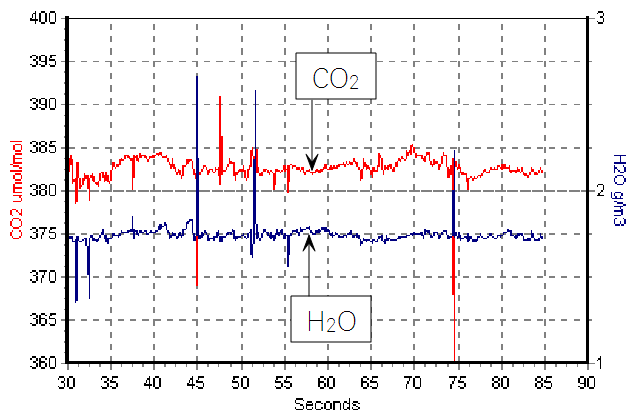
The higher the bandwidth, the more pronounced this effect, since less averaging is done.
Operating in cold weather (<5 °C)
The instrument has a temperature setting that reduces the dissipation of heat in cold weather. We recommend that you change the setting when the average ambient temperature drops below 5 °C. See Initial configuration for details.
Considerations for dust, pollen, and salt deposits
The LI-7500DS is quite tolerant of particulates on the windows, as long as they are small and spectrally neutral. Pollen and salt deposits may become a problem because they are sticky and can accumulate, so monitor the CO2 Signal Strength value and clean the windows as needed.
Operating in environments with high-frequency vibrations
The LI-7500DS is vibration sensitive to frequencies of 150 Hz ± the bandwidth. Thus, if the bandwidth is 10 Hz, the frequency problem range is 140 to 160 Hz (and upper harmonics). The instrument is completely insensitive to vibrations slower than this, and very slightly sensitive at frequencies higher than this.
For land-based installations, probably the most likely source of vibrational problems would be on a tower with tight guy wires. For other settings (aircraft, ships, etc.) where there may be vibrations in the problem range, you should try to minimize the problem through alternative mounting attachments.
Saving the configuration file
A copy of the configuration file can be saved for record keeping or to be loaded onto another instrument. To save the current configuration, click Config File > Save Configuration. Select the items to include in the file and click Continue. Select a directory and save the file. It will have a .l7x extension.